Word Search Answers: How to Find the Last Word (With or Without a Solver)
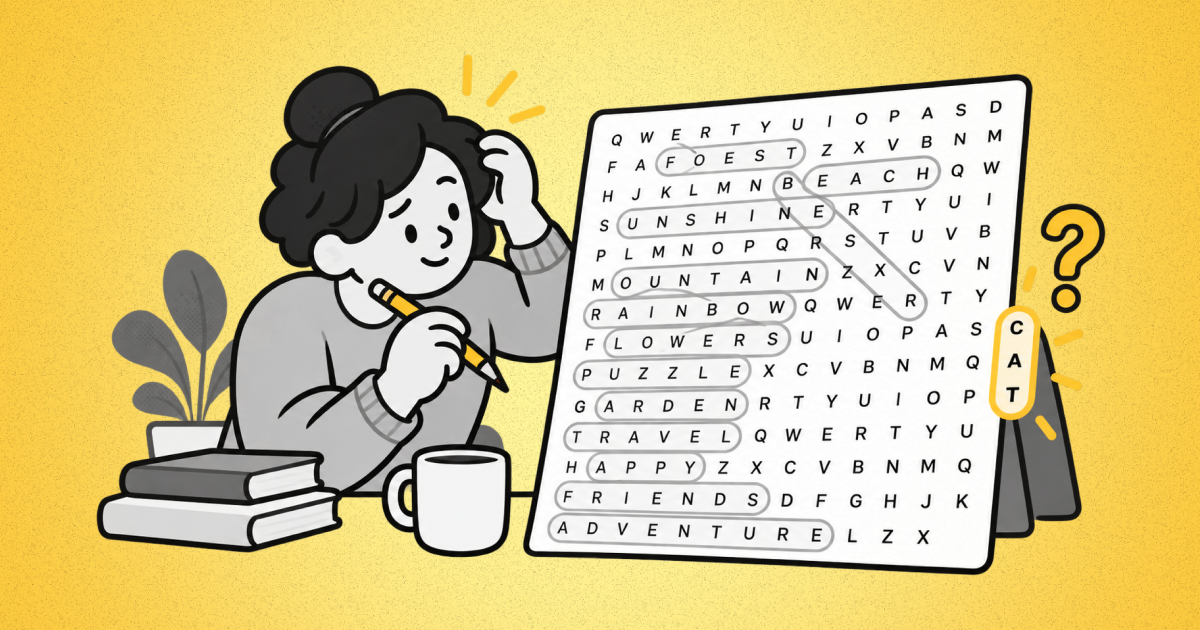
You've circled 19 of the 20 words. The last one is CAT. Three letters, nothing fancy, and you've swept the grid so many times that the letters have started to swim. It's a specific kind of quiet, the kind where you start to wonder whether the puzzle is broken.
It probably isn't.
This guide isn't a speed course. Our word search tips already cover how to solve faster from the first word. This is triage for the last one: the five places a holdout almost always hides, a 60-second checklist to run before you quit, when it makes sense to use a solver, how to sharpen your scanning, and quick answers to common word search questions.
If you're stuck on the final word, need an answer key for a class, build puzzles yourself, or just want cleaner solving habits, this will help you find that missing word without wasting another ten minutes on the same row.
Why Can't I Find the Last Word? The Five Usual Suspects
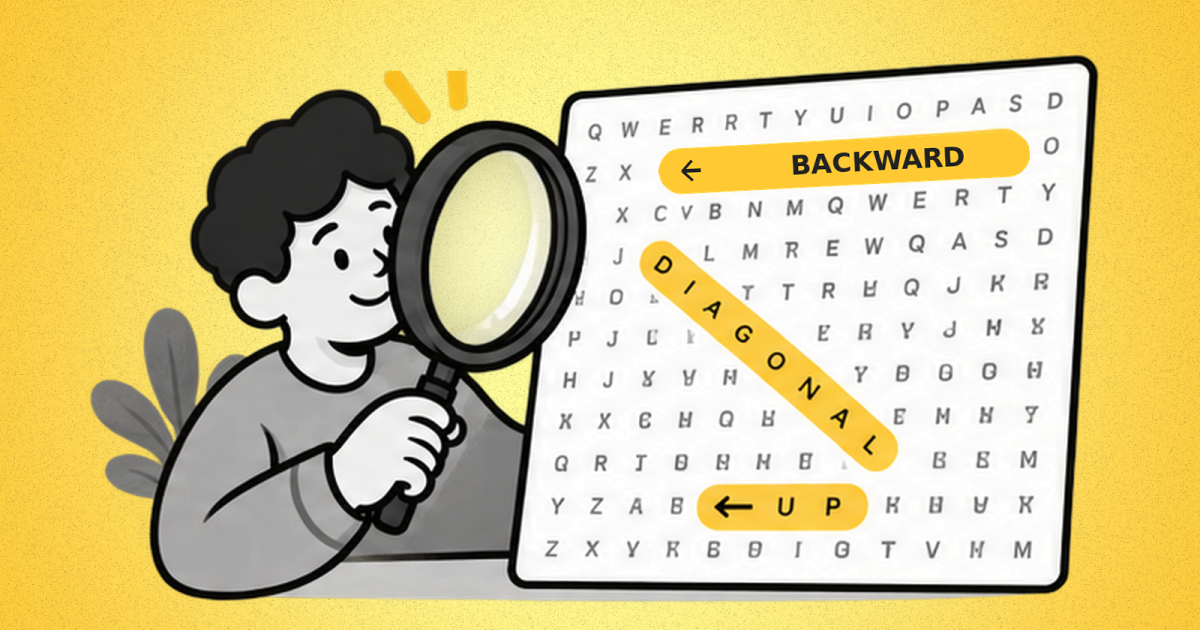
Holdout words aren't random. They hide where human eyes skip, and those blind spots are predictable.
Where it's hiding | Why you miss it |
|---|---|
Spelled backward | You read left to right and top to bottom out of habit |
On a diagonal | You didn't check all four diagonals |
Inside a circled word | Letters you've marked feel used up |
Longer than it looks | Lists often keep spaces, but grids drop them |
Near the edges | Your attention drifts to the middle of the grid |
1. It's Spelled Backward
English readers move left to right and top to bottom so automatically that a backward word barely registers. CAT running right to left reads TAC, and your brain files it under filler. Words running bottom to top vanish the same way, because nothing in everyday reading sends your eyes up a column. Medium and Hard puzzles use backward words for exactly that reason.
👉 Check: Spell the word in reverse (CAT becomes TAC) and scan for that the way you normally read. Or find every C and look left and up from each one.
2. It's on a Diagonal, Probably Not the One You Checked
A diagonal word can run four ways: down and right, down and left, up and right, or up and left. If you check diagonals at all, you probably check down and right, the one that reads like slanted text. The other three each fight your reading habits in at least one direction, and the up-left diagonal fights both.
👉 Check: Find every instance of the word's first letter. From each one, trace all four diagonals, not just the comfortable one.
3. It Overlaps a Word You Already Circled
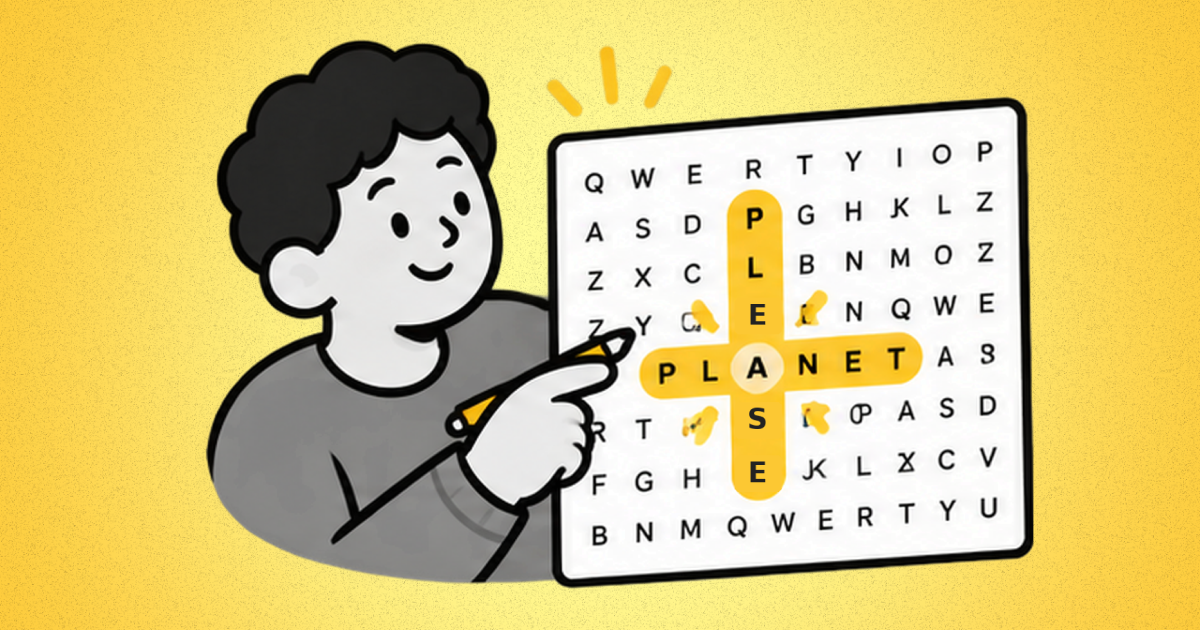
Once you circle a word, your brain marks those letters as used and stops reading them. But puzzle makers overlap words to fit everything in, so the last word may share a letter, or several, with a word you found 10 minutes ago. A circle around a letter feels like a wall. It isn't one.
👉 Check: Look through every word you've marked for a letter the missing word needs, starting with its rarest. If you need a K, the K inside a circled word counts.
4. It's a Phrase, a Plural or Longer Than You Think
Word search grids drop spaces, so ICE CREAM hides as ICECREAM, and hyphens and apostrophes vanish too. Printed word lists often keep the space, which sends your eyes hunting for a gap the grid doesn't have. If the list says DOGS, a DOG with no S after it isn't your word.
👉 Check: Count the letters as written, minus spaces and punctuation. Knowing the length tells you where the word can't be: ICECREAM, all eight letters of it, won't fit in the short diagonals near a corner. Then search for the word's rarest letter (Q, X, Z, J, K or V, if it has one) instead of its first.
5. You've Been Staring at the Same Third of the Grid
After a few minutes, attention narrows. Your eyes keep drifting back toward the middle of the grid, and the edges go unread. Eye-tracking studies have documented a version of this habit for years. People viewing an image on a screen look toward its center more often than its edges, a pattern called central fixation bias. Those studies used pictures, not puzzles, but the fix is the same.
👉 Check: Sweep the outer ring of the grid (top row, right column, bottom row, left column), then move one ring in and repeat. Linger on any patch with nothing circled. Well-made puzzles spread their words across the grid, so an empty stretch is a likely hiding spot.
The 60-Second Last-Word and Word List Checklist
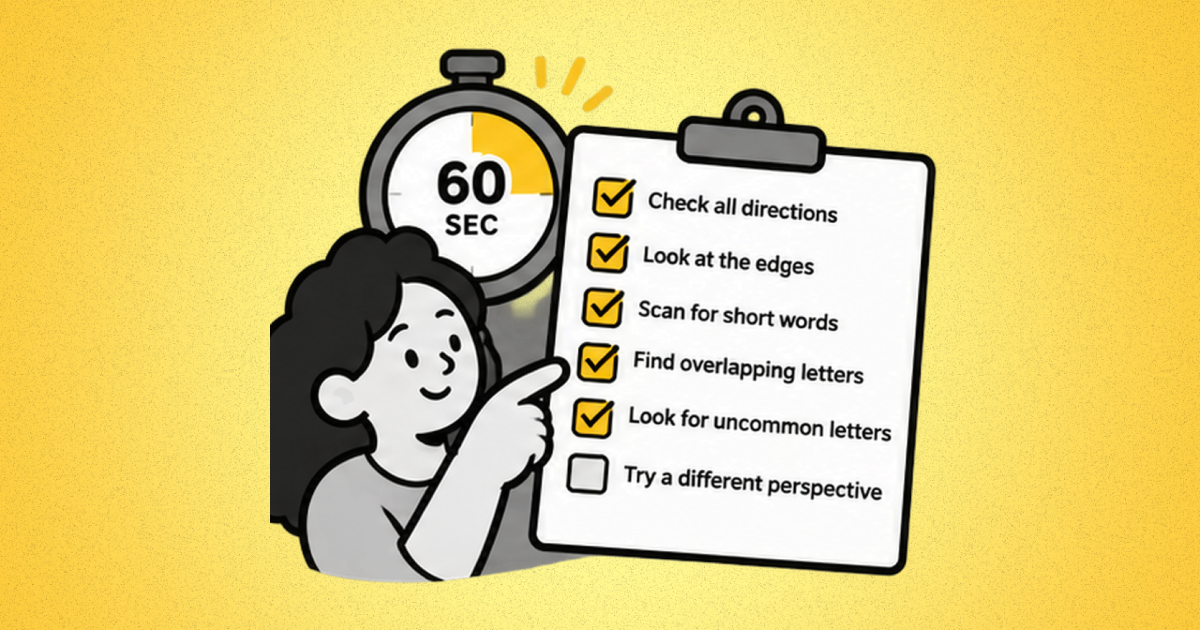
Run these six steps in order before you reach for a solver.
- Count the letters as written. Skip spaces and punctuation, but keep every S and -ING.
- Pick the rarest letter and find every instance. Rare letters stay rare in most grids. When we counted one Daily Max grid, Q, X, Z, J, K and V showed up nine times combined in 225 squares, while E alone showed up 24 times. No rare letter? Use a double letter or an unusual pair like PH; OO, EE, TT, or LL make distinct visual blocks and can act as anchors.
- Check all eight directions from each one. Across, down and both diagonals, plus all four of those in reverse.
- Look inside the words you've already circled, and mark found words immediately so you can track progress before rechecking overlaps. The letter you need may be sitting in one of them.
- Sweep the outer ring, then work inward. Top row, right column, bottom row, left column, then the next ring in.
- Hunt the longest words first, since they cut visual clutter, and note common prefixes or suffixes before searching again. Then look away for 30 seconds. Then come back with soft eyes, taking in the whole grid at once instead of reading it letter by letter.
Run the list in order, and the holdout usually turns up. If it doesn't, you've earned the solver.
When to Use a Word Search Solver (and How)
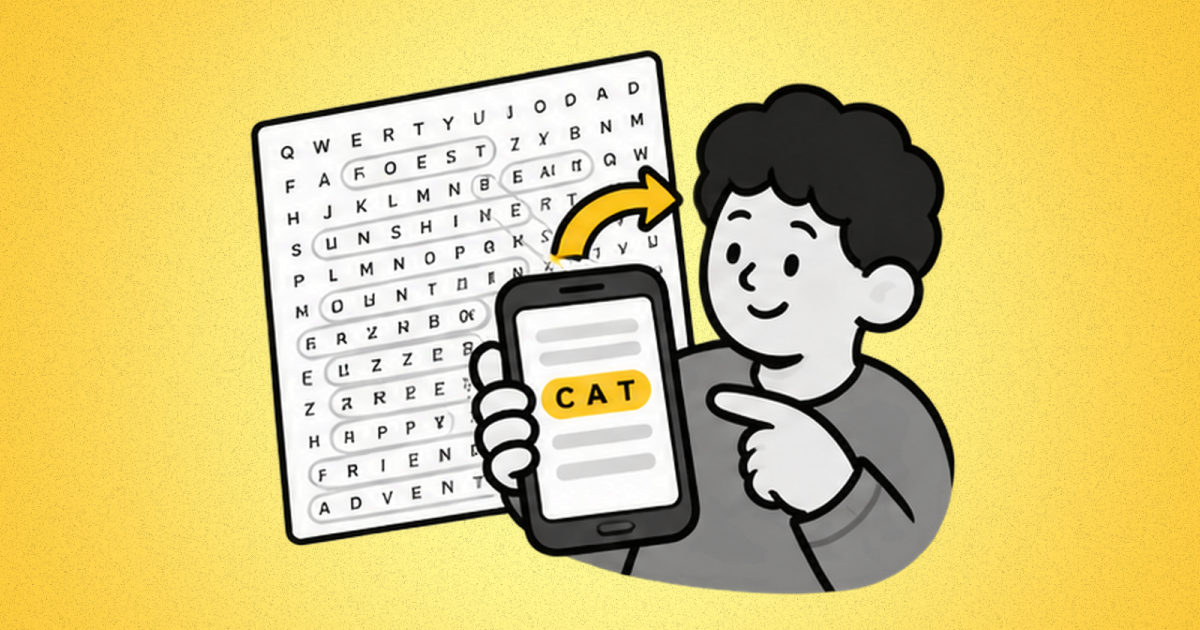
My friend, it's a word search, not some high-stakes game. Nobody's handing out medals, so don't beat yourself up if you can't solve it on your own. A solver makes sense when you're truly stuck in word puzzles, when you're a teacher who needs an answer key, or when it's 11 p.m. and a worksheet is due in the morning. It can also be a useful tool during casual play and, when you review what you missed, perfect help for building vocabulary and spelling skills.
How the Solver Works
- Add the puzzle. Type or paste the grid one row per line, or scan it from a photo or screenshot; advanced OCR reads the letter grid even from lower-quality images. If you type, watch for O versus 0 and I versus l, since one wrong letter can hide a word from the solver too.
- Add the word list. Separate words with commas or new lines, or let the scanner read the list from your image.
- Solve. The solver checks all eight directions and highlights every word on the grid, listing each one's row, column and direction.
To get just the one word, click it in the results. The solver spotlights it without spoiling the rest. For a paper copy, the Print button downloads a black-and-white PDF with every word marked, ready to use as an answer key.
The WordSearch.com solver is free, with no account, no daily limit and no "upgrade to see the last word" wall. It runs in your browser and reads photo scans on your device instead of uploading them to a server.
Other Ways to Use It
✅ Check a puzzle you made. The solver flags list words that appear twice or not at all. Leave the list empty, and it catches words you never meant to hide. For other games, our word finder can turn jumbled letters into hints: enter up to 15 letters, use a question mark as wildcards for blank tiles, and get help with Scrabble or Wordle.
✅ Rebuild a lost answer key. If you built a puzzle with our word search maker and lost the key, paste the puzzle into the solver to get it back.
✅ Settle the argument. The solver will tell you whether the word is really in there. Spoiler: It usually is, and it's often backward. If it isn't, and you typed the grid correctly, the puzzle has an error.
Make the Next One Easier
The long-term fix is better scanning, not more solving. Our word search tips guide covers the techniques that stop words from going missing: suffix anchoring, systematic row sweeps, pattern chunking and peripheral scanning, among others.
For practice, the Daily Mini on our homepage is a quick grid you can finish on a coffee break, and the Daily Max is the bigger daily, a 15-by-15 grid with about twice the words. Both get harder as the week goes on, and from midweek on, words hide diagonally and backward, two of the five hiding spots above.
Frequently Asked Questions
Why can't I find the last word in my word search?
Usually because it's hiding where your eyes skip: spelled backward, on a diagonal you didn't check, overlapping a word you already circled, longer than it looks or near the edge of the grid. Check those five spots in order, starting with backward and diagonal words.
Can words be backwards in a word search?
Yes. Most medium and hard word searches hide some words backward, running right to left or bottom to top, and diagonal words can run backward too. Easy puzzles, especially for young kids, often keep every word across and down.
Is there a free word search solver?
Yes. The WordSearch.com word search solver is free, with no sign-up and no daily limit. Type, paste or scan the grid, add the word list, then press Solve Puzzle to find every word in all eight directions. You can reveal one word as a hint or print the full answer key.
How do I get the answer key for a word search?
Puzzle books usually print answers in the back, and newspapers often run them in a later edition. Many teachers also use a solver to create or recover answer keys for classroom worksheets. For any other puzzle, paste or scan it into a solver and print the result. WordSearch.com printables come with an optional answer key too.
Is using a word search solver cheating?
Not on a puzzle you're doing for fun. Some people call a solver a cheat, but for casual play and practice it works fine as a reference tool. Checking the one word you can't find is no different from flipping to the answers in the back of the book. It's another story in a competition or on a class assignment meant to build the skill. For practice, reveal only the missing word, notice which direction it ran, and refer back to the missed pattern so you learn from it.
What's the hardest word to find in a word search?
Usually a short word made of common letters, placed backward on a diagonal. A three-letter word like CAT has many near matches in a typical grid, so your eyes keep snagging on false starts, while a long word with a double letter can be easier to spot; for example, LETTER stands out more quickly than CAT because that repeated pattern gives your eyes a clearer target.
Still Have One Word Left?
Run the checklist first. If the word still won't show, the word search solver can point to that one word and leave the rest of the puzzle alone. To stop getting stuck at all, practice on today's daily word search.
 Mini Crossword
 Midi Crossword
 Diffle
 Killer Sudoku
 Numberle